Wednesday, May 27, 2009

Croatian History - Ethnic, Religious Groups

Croatia, graveyard; child Therezia, age 16

A trip may seem self-contained: see this, go see that. Then the reading later shows how interrelated regions and peoples are.d

Here is the face and figure of the child, Therezia, who died at age 16 - a random stop to walk slowly through a graveyard. Who was she. How did she die. Who were her people.

Croatian history: It began with the Greeks, see Croatian History at //www.geocities.com/i_canjar/history/crohistory.htm/ who established colonies in 600 BC. Then, much later, from an area of the Ukraine, came the Croats in the 6th Century AD. They defeatede the Romans and others at the Adriatic Sea area, many ports there, in about 614-635 AD. TGhey beat back the Avars, another group, back to the Danube: then were awarded lands under the sovereignty of the Byzantine Empire, that became the Orthodox branch of Christianity.

King Tomislav first ruled over a unified Croatia - then begin the back and forth wars and migrations among Montenegro, Bosnia-Herzegovina, Istria, other regions, and then the Turks (Ottomans) leading to tensions that persisted and augmented both World Wars, and to today in some regions: Orthodox Christians, Roman Christians, Hungarians, Muslims, Magyars.

The capital, Zagreb, became a seat of a Bishop in 1094.

Wednesday, August 06, 2008

Jasenovac - Death of Dinko Savic, Leader of Death Camp

The death camp at Jasenovac is now nothing but a leveled park area, with closed museum, locked bathrooms, vacant and dry fountain memorials. Just some maps on pedestals, explanations at ground level as to the mass graves beneath your feet, an old train on a track with bullet holes, used for transport. An occasional biker, a man on a mowing machine, a willow. All its memorabilia sent to Washington DC, the Holocaust Memorial.

That is a disservice to the people of Croatia. The memory is being erased.

A reminder this week of Jasenovac: the death of Dinko Savic at age 86, reportedin the New York Times 7/23/08. The article says that the camp was known as the "Auschwitz of the Balkans," yet is is abandoned. No tourists. Nobody. He used to ride in on a white horse, with black boots, black uniform, whip and machine gun. Say survivors. He fled to Argentina and lived there for 50 years, and not in hiding. He said in his last years he was "proud of what he had done and would gladly do it again." NYT.

He died in Zagreb, the capital of Croatia, in Croatia serving a 20-year prison sentence. Crimes against humanity. He was found guilty, himself, of killing 2000 Serbs (Orthodox Christian, not Roman Catholic, and the Roman Church stood by, see post here on Cardinal Stepinac), Jews and Gypsies. Can we dare forget how they died? Withholding medical treatment, working ot death, hanging and leaving dangling in some cases until dead, if not immediately killed; personal shootings, including for smiling say some survivors; torture with blowtorch; starvation. When convicted, he laughed and clapped his hands.

The issue - proFascists - the numbers are exaggerated. Against - they are underestimated. But noone will exhume, in case the other side is proven right. Highest estimates of totals are in the hundreds of thousands. Lowest? Tens of thousands. So everybody go home and forget. There is not even a sign on the highway identifying it as a concentration camp.

Read more at ://www.thestar.com/News/World/article/466369, the same as appeared in the NYT; and ://www.statesman.com/opinion/content/editorial/stories/08/08/03/0803reich_edit.html

Monday, March 24, 2008

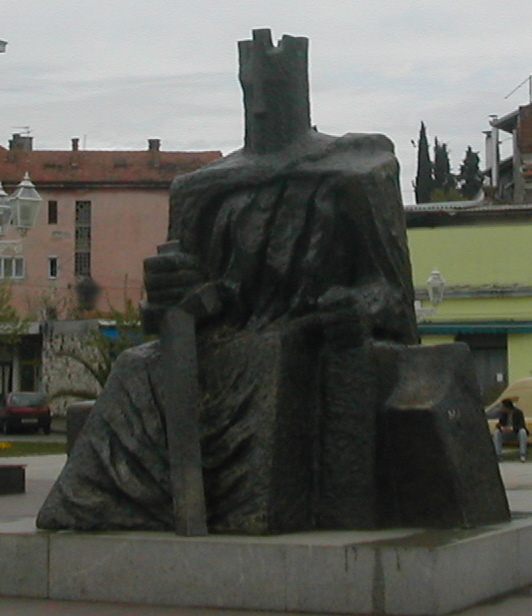
Zagreb - Officer Yellachitch Now ID'd as King Tomislav

King Tomislav Takes His Rightful Place

We had thought this to be an Officer Yellachitch, or Jelacic. Thanks to VM, we are back on track.

This is in the capital, Zagreb, Croatia, at the entrance of the magnificent old train station, near the grandest hotel in Zagreb.

An email from VM re-identifies this as King Tomislav, crowned 925 AD Croatian King. More at ://en.wikipedia.org/wiki/Tomislav.

VM refers us to www.croatian-king-tomislav.com/ where a Mr. Mojmir Damjanovic of Australia is researching where King Tomislav is buried, and even locating the actual Crown - looking for "the father of independent Croatia."

The site notes that little is recorded in history texts about the kingdom 923-1102 AD.

Tomislav was crowned in 925 AD (summaries here) by the Holy Catholic Church in Rome (note that this is before the later division in about 1000 (?) between the Latin-Roman Catholic Church and what we call the Eastern Orthodox or Orthodox Christian Church.

The later ecclesiastical division occurred when the Roman branch pulled away. At the earlier time, there was still only one Holy Catholic Church, as I recall from reading). Tomislav "disappeared" and then was "declared dead" in 928 AD.

There was discord ongoing at the time about whether the Croatian Catholic or the Latin Catholic Church should control.

The Croatian Kingdom, says the site, was "mightier than England at the time, mightiest in that part of Europe."

Was the death a "planned strategy" to "quash its strength and its power, to deny the Croatian nation self-determination and its name; its independence." To be continued. Connecting other things here as well.

Thank you, VM.
........................................................
* VM's modern spelling for the name is "Jelacic" and this recurrent translation-phonetic range is a challenge to any research. I used the "Black Lamb, Gray Falcon" spelling from 1937-41.

The Officer, as I looked again at "Black Lamb" originally used to identify the statue, is in the market square, "Jelacic Square." We are learning.

Yellatchitch-Jelacic according to "Black Lamb" is the 1848 hero who had been appointed Ban of Croatia, brilliantly repelled the Hungarians, and thus preserved the Austrian Empire from the Hungarians. VM writes of him with the title "Ban" for "Viceroy" and a Croat General who crushed the Hungarian rebellion. But he was then was promptly shoved aside, as other powerful interests and people took over. See knigite.abv.bg/en/rw/rw_epilogue1., the 1937-41 book, "Black Lamb and Grey Falcon," by Rebecca West at the paperback version pages 53-56, Penguin Books 1994.

Read about the old Zagreb there: here is the Epilogue at knigite.abv.bg/en/rw/rw_epilogue1, Old Zagreb, "Black Lamb and Grey Falcon." I took the whole book in paperback, but cut it in half. Too thick as a single paperback, too heavy as a hardback.

Zagreb - Metropolitan: Cathedral, Mirogoj Cemetery, St. George, underground mall

The lower new town of Zagreb, off the hillside-cliff defense area, is cosmopolitan with parks and grand statues and great Viennese-style avenues and buildings, for business. Days of the old Austro-Hungarian Empire.

Here is the huge old (cloak and dagger?) railroad station, the main stop for passengers coming from Vienna and on to Belgrade or elsewhere, and back.

You can see the influence of the old Austro-Hungarian Empire in most all of the buildings and statuary. The tiled roof is on St. Mark's. We found more people who spoke German than English. See fine photo gallery at www.pbase.com/ralf/zagreb&page=all.


In the Cathedral of St. Stephen is the burial place for Cardinal Stepinac, whose activities during WWII are a discussion point for those concerned with the role of church officials in wars. Stand aside, or give up your life for your friends? For a favorable review of what Cardinal Stepinac decided and when, see www.hic.hr/books/stepinac/english/second; and for a less favorable account at www.philologos.org/bpr/files/Vatican/vs001a. Fine minds differ.


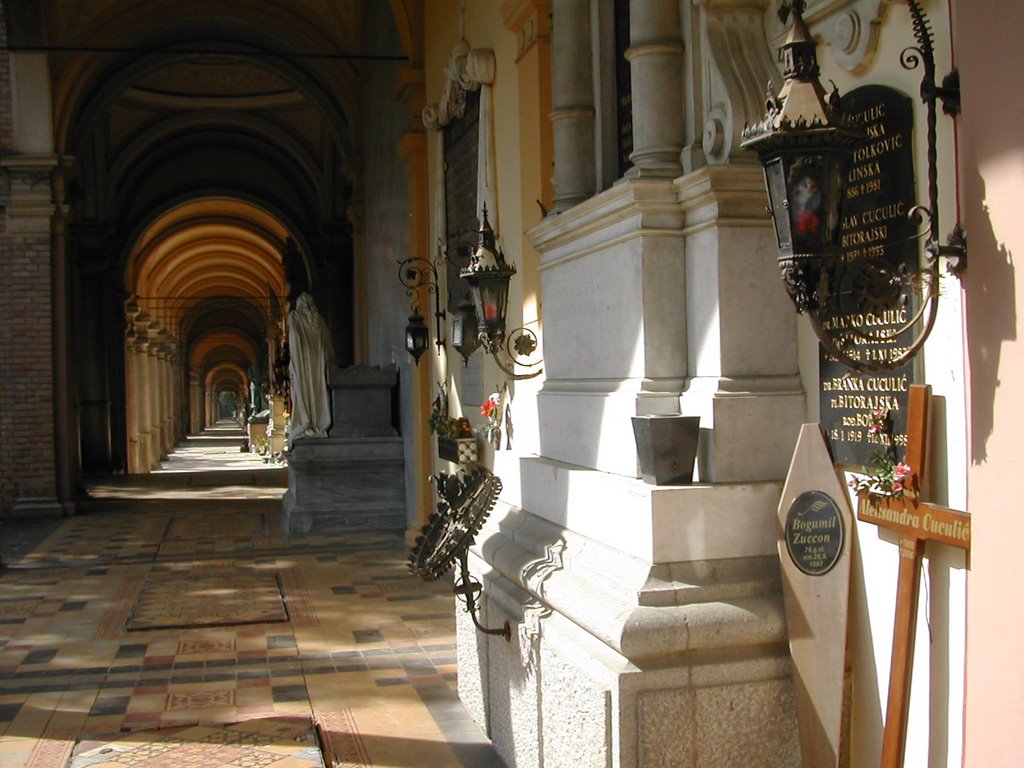
Miragoj Cemetery. This has been a heavily Orthodox area, and the big Mirogoj cemetery, just outside Zagreb, has many if not almost equal Cyrrilic alphabet monuments, or other Orthodox symbols.


There also German soldiers from WWII are interred with a carefully alphabetized common marker, with names and full birth and death dates.


There is a former Croatian president here, Mr. Tudjman, and artists, literary figures, professionals. Their locations are mapped; or just follow a tour group. One travel site has little on Mirogoj, and asks for input, but their motto is something like, find what is true, then travel. See www.tripadvisor.com/. We do the opposite - who says what is true and why? Go and find it out yourself, or try.


Here is St. George, battling the perpetual dragon. Moisture drips from his toe, but this is not seen as miraculous as in some other religious statuary. See example at Bosnia Road Ways, Medjugorje site .

The earliest "known" dragon may be at Mesopotamia, from the time of King Nebuchadnezzar.


Collateral and unrecoverable damage. Is there any archeological evidence of anything left there, after Operation Iraqi "Freedom." See information on collections at www.dia.org/collections/ancient/mesopotamia/31.25. Dragon forms were also in Egypt, see www.ancientworlds.net/aw/Article/799168, and in various eastern and western cultures, see www.draconika.com/culture.php.

More on dragons: A TV show (history channel? sponsored by the army??) recently, in September 2006, said that dragons were also in Mexico, Alaska (!) . and we have seen the dragon boats in Viking cultures. Were they real once? Here is the story of a knight and the dragon, and saving the lady, from Libya: www.kellscraft.com/stgeorge.

Sunday, March 23, 2008

Zagreb - King Tomislav Crowned 925-Disappeared 928 +/- AD

This is a followup to an earlier post, December 7, 2006, * correcting the identity of a statue in Zagreb, that we believed to be a General or Officer Yellatchitch (Jelacic). Jelacic was an early 19th Century Croatian who fought the Hungarians successfully on behalf of the Austrians in the early. The statue pictured, turns out to be a far earlier King - King Tomislav, crowned in 925 AD.

Roots go deep - and this learning about an obscure King leads to a mystery, laid out at the earlier post. It adds to our concern 1) that history is shaped by the victor's spin,and may well not be the history that happened at all, and 2) religions do not expand by truth, but by politics and strategic killings through the centuries; and 3) that countries that are not the empires any more, like Croatia that was on the verge of greatness and expansion at the turn of the millenium, are no less worthy because their leaders were overcome, than those who scrabbled themselves on top.

The followup: See the Zagreb post, King Tomislav, earlier believed to be Officer Yellatchitch, or Jelacic, now understood to be Viceroy and even General Jelacic, Officer Yallatchitch (Jelacic).

The purpose of this post: we refer you to a statue that we now believe to be King Tomislav himself, in Bosnia - Bosnia or great parts of it once was part of the larger Croatian sphere of influence at that time, 900-1100. We have to check the dates, bu see Bosnia Road Ways, Capilyn, Statue. The inscription, based on what we have been told by one VM (see the Zagreb post) shows that King Tomislav was crowned at Capilyn (there is a closer phonetic spelling that I have to look up) and that is probably why the statue is there.

King Tomislav mysteriously disappeared some three years after his coronation, in the context of a dispute with the Roman Catholic or Latin Catholic branch of Christendom, where the Croatian branch had wanted more autonomy.

All it takes is access to the Vatican's library - bet they have all that is needed in there. Ask for a library card.

Connections, connections. Look up the Nin post here and Bishop Gregory of Nin there, and the guides tell us that he had wanted to do the Mass in Croatian but Rome stopped him. Post dated January 26, 2007.

This Blogger Beta is impossible. We can't even find our own archives without the titles on them. Is anyone listening out there?
.........................................................................................
*and I am getting so tired of Blogger Beta I could scream. The earlier version of Blogger enabled us to show titles of blogs in archives, in a column so readers could find earlier references. No longer. I have to pay a techie to do it now, and that is ridiculous.

Wednesday, January 16, 2008

Croatia now, reflecting then. Contemporary rock concert, WWII history, clash.

Who collaborated with the Nazis, who didn't, who was responsible or did not intervene effectively enough in the deaths of so many Orthodox, Gypsies, Serbs, other Croats, others, all this lives on in current events.

11/1/2007 - NYT Arts section. A Croatian rock group's concert, that had been scheduled for the cultural center run by the Croatian at the Church of St. Simon and Methodius, located at 10th Ave. and 41st St. It was canceled said spokesman Mark Weitzman of the Simon Wiesenthal Center (a goal there is to counter anti-Semitism),because of protests that some lyrics glorified the WWII government, the Ustache, that was a flip side of the Nazis in terms of support. The artist: Marko Perkovic (Thompson is the stage name). Apparently there is a slogan in a song that echoes the Ustache regime.

Protesters included Nenad Milinkovic, of a Serbian-American church in Manhattan.


The names of saints recur in many countries - and people bring them to where they emigrate. Connections, connections.

Saturday, September 08, 2007

Croatia; and the Old Yugoslavia. History of Central Europe

Every so often, we come across a site to be passed on to you.

We think: Among the best history sites is at History of Central Europe at //mysite.du.edu/~etuttle/misc/europe.htm#Mong.
Scroll to the part especially about the relations between Croatia and Serbia. Roman Catholic v. Orthodox Christian; Roman alphabet v. Cyrillic, etc.

Friday, September 07, 2007

Attila and Istria


Istria and famous people. Istria is the peninsula on the northwestern part of the crescent that is Croatia, bordering Trieste, Italy; and Slovenia.

It appears that like Attila the Hun died in Istria. See istrianet.org/istria/history/0000-0999AD/huns-goths/attila-death.

This is not Attila. If you thought it was, then you have been influenced by all the pro-Roman constructs that are part of our biased culture and have been for centuries.

This instead is Roman. The ruins of the Roman Empire are very much a part of Croatia (see the town of Split in particular here). Here, the Roman fellow registers frozen surprise at being caught corrupted and impermanent after all, and the empire toppled.

Attila probably was not the 100% barbaric villain we are taught - instead, read of his virtuous and admirable sides. Look, chew and decide before swallowing. See Bogomilia - A Site for the Unsung. He was a barbarian, originally meaning not a Greek, see www.wikipedia.org/wiki/Barbarian.

Read a contemporary account. Go slowly through this Medieval Sourcebook, Priscus at the Court of Attica, a report of Priscus' of meeting with Attila, and his court. Read it all. Especially paragraphs 5 and 6. Not bad. Priscus was a Goth historian. See www.wikipedia.org/wiki/Priscus.

Saturday, July 21, 2007

Food -- Ajvar, scampi buzara, cevapcici, slivovicz, Vegeta (r)


Food. The national relish. Ajvar: pureed red pepper and eggplant spread. Bright red. Served with salads, meats, on its own. Everywhere

Buy at Balkan food supply stores, or the international section of a big supermarket. Now, our recipe: Take half ajvar, half crushed tomatoes, some rice wine vinegar (or balsamic) splashed to taste, and it beats ketchup.

See how to make ajvar at www.necessaryjourneys.blogspot.com/2005/10/walking-on-my-stomackor-how-to-make.

Scampi buzara: www.croatiatraveller.com/Recipes/buzara. This uses Vegeta, a seasoned salt used in so many Balkan dishes. It has dried vegetable bits and is available at our supermarkets now, in the international section. Does have msg. I use it even in eggs now.

Also try the ground meat patties/sausage with Vegeta, cevapcici, at www.xpat.nl//journal_archief.

In Romania, tuica.
In Croatia, slivovicz.
Or slivovitz. See www.yourdictionary.com/ahd/s/s0478600
And a history of spirits-making at www.abbeville.com/Products/Excerpt/0789201658Excerpt.htm.
Excellent.

Monday, July 09, 2007

Update: Jasenovac concentration camp


Fresh evidence of how successful a policy of sweeping bodies under the grass can be. This is an update of an earlier post on Jasenovac at 12/6/06.

Just look at it. How could such a pretty park signify programmed mass murder? A memorial indeed gone from memory again. The new Ripley's: here is Jasenovac, the WWII concentration camp. See earlier Jasenovac post.

An article in the New York Times, 7/2/07, International Section, by Nicholas Wood, points out the concern of Daniejel Ivin, president of Croatian Helsinki Committee for Human Rights: that people are being taught that Ustache actions, (the WWII ethnic cleansing and religious-cultural genocides of Serbian Orthodox, gypsies, Jews, others, and with established-church people remaining essentially passive) no worse than other actions of leaders in the later Yugoslavia.

The joy of oblivion - see the photo in the article, of young fans gesturing in the old Ustache (WWII Croat puppet government) salute, and wearing old symbols of that era, including swastikas, and apparently uncaring about or ignorant of their holocaust-totalitarian significance.
Come again?
No wonder kids treat these symbols as nothing more than rockstar fun. Jasenovac concentration camp is now an ignored and unsung bit of acreage, with a rundown memorial tulip, and abandoned museum). There are some reminders in bronze maps and paths through beautiful pond area, but the real history has successfully been remade by the victors.

Monday, June 18, 2007

Hungarian population in Croatia - near Sisenik


In this traditional Hungarian neighborhood, near Sisenik, also near Zagreb (the capital), the houses are wood. They are distinctive from the other Croatian houses, that appeared to be a stone or brick, or stone/brick covered with stucco.

There were vast migrations of Magyars from the area now known as Hungary, throughout Eastern Europe. These houses also look like the traditional wooden houses in Poland. Don't know enough about the populations to tell the roots. Wikipedia says that there was a relationship between the Croatian and Hungarian groups, sharing a sovereign, from 1102-1918. See en.wikipedia.org/wiki/Kingdom_of_Hungary.

Sinj - Above-rock Cemetery

Near Sinj. With the land so rocky, and karst hills, cemeteries may be surface mausoleums, in terraced rows.

There is the church, again on top of the hill for defense.

We came away with a fuller sense of "refuge" after seeing so many of these lone buildings, or perhaps forts and castles, silhouetted up there.

Istria - Real Estate Values

Look to the background and see just the tips of the Alps at Slovenia. This view is from the coast of Istria. Istria is a province of Croatia, that also borders Italy and Slovenia.

For second home buyers, consider northern Istria. The New York Times, 5/25/07, notes similarities between this province in Croatia, with Tuscany. Compared to prices in Split or Dubrovnik, homes are relatively inexpensive. Munich is only 5 hours away, says the article. "The Tuscany Life in Croatia: Second-Home Shoppers Look East for a Place in the Sun," by Brett Corbin.

Planes and title searches. No direct flights so far from US; and land use can be separated from the land in inheritances, reports Mr. Corbin. Be careful if you decide to fly into Venice, an hour or so from Trieste, and drive over. When we rented a car, a Trieste rental was not allowed into Croatia, but a Croatian rental was allowed into Italy.

Sunday, June 03, 2007

Templars, road from Osijek to Verajdin

Knights Templar accumulated great landholdings and many towns are said to have originated with their economic activity. This is the ruin of a fortress in a Templar area on the way from Osijek to V.erajdin. ,We took a non-motorway route across the northern area, just past the agricultural panhandle and moving back into hills and mountains.

The dirt road that looked like it was going to the fortress and town up there looked ok, but rapidly became rutted and rocky. I became rapidly uncomfortable, so we backed down. Literally.

Near Osijek - The agricultural panhandle. Carnival, old grave


The pleasure and privilege of a car. Stop a while. At will.

See the world's universals, up close if you want. Here is a carnival camp. Get out. Walk a bit. Breathe in. Breathe out. Again. Let time pass.

Wander in an old graveyard off the road. Find a girl's face. Hello. Terejiza. Her picture, in ceramic, holding a book. A direct gaze. What happened?


A river, the view from the trestle bridge. Do not do what we did . We followed some local people up the staircase to cross the bridge on the pedestrian walkway. When we came down, a train came by not long after. I looked back up, and saw the other people standing firmly by poles, arms around, back to the train, with the nonchalance of experience. Would we have had the wits to do that? Never go on railway bridges. Never. Not even when there is a pedestrian walkway.

Wednesday, January 31, 2007

Dubrovnik -- Dalmatian Coast


Dubrovnik - famous walled city. Also a World Heritage Site. See whc.unesco.org/en/list/95.

Red roofs. Bombed heavily by Serbia during the wars, now restored. There can be no full recovery of the destruction of actual original heritage sites, however. There remains a botox quality to the reconstructions.
And regular people living there. Here is some street soccer, seen from the city walls.


An ideal 8-day trip would be to fly into Dubrovnik, drive around the walled cities immediately up the coast and back, then do two days in Montenegro to see the spectacular mountains. Take the ferry to Korcula sometime in between. Croatia also has mountains, but they are a barer rock than in Montenegro, with all the deforestation (thank you, Venice and others, who conveniently ravaged Croatia to build your fleets with Croatian timber. Overview of Dubrovnik - see www.visit-croatia.co.uk/dubrovnik/.


Dubrovnik was heavily bombarded during the 1990's Balkan wars, but is largely and well reconstructed. It is not like Germany, where the reconstructions are easily visible because of inelasticity. In Dubrovnik, for example, they used old techniques and reusable stone. Then again, they did not have an entire country the size of Germany to rebuild.

Tuesday, January 30, 2007

Cavtat - Dalmatian Coast on the way to Montenegro

Cavtat, Croatia, bay view


This is on the way to Montenegro, south from Dubrovnik. Take a few days to at least see the start of the mountains, and coast. See Montenegro Road Ways.

Cavtat is a good stopping point on the way - an ancient coastal town now mostly resort and marina - see photos at pictures.cavtat.com/. We arrived at dusk, in time for a great "riva" or harbor-walk promenade that goes out to a long point of land. The promenade begins just past that parking area. There is a dredger, and the view is from our hotel. By morning it was raining. That view is from our hotel.

The town dates from the Illyrians, the Greeks and Romans, www.cavtatportal.com/pages/cavtat_then_and_now. Many hikers, adventure-climbers at the hotel. Easy to get a several-day car rental also. See dalmacija.modrojezero.org/Cavtat/index.

Split - Dalmatian Coast, UNESCO

Split, known for Diocletian's Palace and St. Bartholomew's demise.

Split is a large commercial and historical center. It is the coastal town where the Roman Emperor Diocletian built his huge retirement palace, with room for the army. See w3.mrki.info/split/diokl. It later was a refuge for people fleeing the Turks, who set up their own town within the old Diocletian's palace walls. People still live there - shops, residences, cafes - a village within a palace. It is some 7 1/2 acres, some 220 buildings. Split was Diocletian's home town originally - a Roman Emperor from Croatia.

The group on the steps in the AM tuxedos is a vocal quintet, performing classical and traditional music. You can see the old palace behind. We bought their CD, so their tuxedos were successful marketing - good for them. More on culture at Split, see www.lacity.org/SisterCities/split1.

Word on Split and other towns on Sunday nights: Eat early, or you will be into fast food until 8PM, and nothing after that but peanuts if you are lucky, in a pub. We had thought we could enjoy a nice dinner on Easter evening - rain on Easter morning at Pag, Nin and Zadar - dining at the usual after 8PM - but we ended up with the peanuts. Really. The positive side was the pub - political discussions on the search for people from the wars, proceedings at The Hague, and ethnic views.

Split is the second largest city in Croatia, after the capital, Zagreb. It is a UNESCO World Heritage site. See whc.unesco.org/en/list/97.

The Emperor Diocletian ordered the death of St. Sebastian. Sebastian did not die of his arrows, however, but the myth persists that he did. He did not live long, however. Diocletian issued further orders. See www.marquette.edu/haggerty/collections/sebas. Advances?

Monday, January 29, 2007

Sibenik - Dalmatian Coast, UNESCO

Sibenik. Walled city,. The Cathedral of St. James. Adam and Eve at a doorway. And the ring of faces. Over 70 sculptured faces on the cornice going around, faces of ordinary folk - not saints, not famous civil officials, just people - expressing every emotion. For more on Sibenik's history: www.lemaxc.hr/sibenik/history.


Traveling from Zadar, stopping off and on.
There is a motorway, but we avoided it. We took the coast old road instead, small towns with fine food, go slow around the curves, cliffsides, maybe not guardrails, but people are careful.

Croatia has a history of valuing common people. It is the country where the people's language was used by Bishop Gregory in the 10th Century, until he was stopped by Rome and compelled to use Latin, that the people could not understand. See post on Nin. So, seeing a veneration for common men and women as shown on this Cathedreal, and for their lives, was not as jarring here, as it would be in Rome. The Cathedral is a UNESCO World Heritage site. See whc.unesco.org/en/list/963.


This was flower market day in Sibenik. Other days focus on meats, produce, or goods.

We hear so much of Balkan turmoil. A less explored idea, in connection with that, is where it came from. Location, location.

The Balkans were the first stop for the Ottoman Empire expansion, The Balkans had to be the buffer for violence for centuries, enabling Venice, Austria, Hungary, France, Germany to develop at least without that threat on their doorsteps. The Balkans absorbed it. Albania has never recovered from the conqueror doing what conquerors do - exploit. The upending of the religious and political landscape. Bosnia, Serbia, Herzegovina, all part of that heritage. Need more research here.

You and I can start with these lectures on Balkan history: at www.lib.msu.edu/sowards/balkan/.

..........................................................
Books read on the way and after home:

Black Lamb, Grey Falcon: A Journey Through Yugoslavia, by Rebecca West (1939). This is so big as a paperback that I sliced it in half, used heavy cellophane on each as a new cover, and then could read it. Old, but no comparison as to history, philosophy, geography, social customs, all in pre-WWII.

Cafe Europa: Life After Communism, by Slavenka Drakulic, 1st American ed.

Balkan Ghosts: A Journey Through History, by Robert D. Kaplan, St. Martin's Press 1993

Sunday, January 28, 2007

Zadar - Dalmatian Coast


Easter Morning. In drizzle, we went on from Nin to the larger town, Zadar. At this site, dalmacija.net/zadar, click on "city tour" at the bottom menu. Very cosmopolitan.

From the traditional to the contemporary: here is an upscale urban and very contemporary family at the nearby city of Zadar, see Zadar, the Cathedral of St. Anastasia, see legends, Zadar, built on the grounds of the old Roman forum. The cathedral is being repaired. For American Croatians interested in their history, see American Croatians.

Zadar has been proposed as a World Heritage site. See Zadar Proposed World Heritage.This family could be from any major urban area. There is ongoing reconstruction work. The city dates from the 9th Century BC - with layers of each cultural group's influence all around - Gothic, Renaissance, Baroque, large areas of big walls. We may think of Croatia as distant, but it is just across the water from Venice. Upkeep ongoing.

There is a Christian Orthodox bishop here and a Roman Catholic bishop.

Croatian coats of arms are prominent in bookshops, displays, town information, and Wikipedia (always good for an orientation) does a good job in describing Zadar, and with a map, and including its coat of arms. See en.wikipedia.org/wiki/Zadar.

Senj and the Uskoks - Dalmatian Coast - An Unknown People

Still the Dalmatian Coast, but farther north than the usually seen walled cities.

At Senj, there is a fortress at the top of the hill behind the port town,. A large valley in the mountains funnels to the sea. See overview at www.senj.hr/English/Geographical_pos. There, refugees from the Turks, Uskoks, fled and set up a town, and fought back. See www.lickosenjska.com/senj/senj1_e/senj1_e.

The Uskoks had helped the Venetians, by fighting back the Turks, and enabling the Venetians to disengage and just keep paying financial tribute to the Turks, instead of fighting themselves, say the books. Ongoing research - see lookups at Bogomilia: A Site for the Unsung

Then, when the Uskoks through their experience in battle and on ships were getting too strong, the Venetians turned against them, eventually destroying them and dissipating their numbers. The Uskoks had become great seamen, managing the winds that even the Venetians could not; so they became pirates. Always check up on Wikipedia because the information can be updated, or left erroneous - but this looked accurate, in line with what we think we learned: en.wikipedia.org/wiki/Uskok.

Courage, flexibility, adaptability, and drive. All for nothing. Just another page in history. But it is good to see how school children now can tour the fortress up there,and see the great crests of the old Croatian families lined up on the walls, and read of the great struggles for independence and dignity of the past. There is huge post and beam construction that still holds up, for you builders. The town looks like this, I believe this is Senj, but if it is a neighboring town, Senj looks like this from the top where the fortress is. We walked up there. We try to take notes, but sometimes get pictures mixed. For a scholarly long article, try The Uskok "Problem" at etext.virginia.edu/journals/EH/EH42/Simon42.

Friday, January 26, 2007

Nin on Easter morning - Dalmatian Coast

Nin, Croatia: Parishioner, Easter Morning

Easter morning. Meet a parishioner on the walking bridge of the ancient town of Nin, going to St. Cross. The sun had just began to show after downpours at Pag, to the northeast.

She wears traditional dress, black formal wear that we understand is expected for widows, and for occasions: black stockings and shoes, a full skirt, and here she has the babushka and a short black overcoat. Sometimes there is black embroidery. Here, not.

Nin is the oldest Croatian royal town, says dalmacija.net/zadar/ see also ://en.wikipedia.org/wiki/Tomislav.

King Tomislav, who ruled 910-928 (becoming King in 925) had conquered the coastal cities of the Dalmatian Coast, and issues arose as to the sovereignty of the Archbishopric of Nin here and Bishop Grgur. Gregor. Gregor. Gregory. Of Nin. See Tomislav at Bosnia Road Ways, King Tomislav, Capilyn

Nin and the next and larger town, Zadar, are often grouped together in write-ups. Go to the middle of the page for a writeup on Nin. Nin is off the main road going from Pag to Zadar, on the Dalmatian coast. Seewww.dalmatianet.com/_destination/region-north-dalmatia/ for both Pag and Zadar.

Nin once was a major port and commercial hub in medieval times. I wrote to the priest there and enclosed this lady's picture, but have not heard back.

This is the old bridge where we met her.

Nin, Croatia, bridge


Nin, Croatia: Bishop Gregory, Gregor of Nin


This is Bishop Gregory of Nin, a strong 10th Century Christian religious leader who used the Croatian language in liturgy. See more on Gregory of Nin at www.answers.com/topic/gregory-of-nin. He finally was stopped by the Pope, who wanted only Latin used, with the result that the people could not understand.

The feet or hands on many statues of saints, like the large toe of Grigor Nin here, are rubbed bright with the touchings of people with supplications, or just for luck for the rest. The statue is by the sculptor Mestrovic, with the original here (or is the original in Split??) and a copy in the second largest city, Split. See www.virtualtourist.com/travel/Europe/Croatia/Dalmatia_Split_Region/Split-384998/Things_To_Do-Split-Grgur_Ninski_statue-BR-1. Scupture traditions, Split.

Nin, Croatia: Cathedral, St. Cross, claimed as world's smallest

Nin has the world's smallest cathedral, St. Cross, dating from the 9th century.

For full listings of the major religious buildings in Croatia, including at Nin, see Monuments, Sacred A more detailed accounting of history and Nin, and other statues of Grigor Nin is on a blog at Nin blog

St. Cross Cathedral, Nin, Croatia (world's smallest?)

Pag - Dalmatian Coast , karst , salt and deforestation

The Dalmatian Coast has its barrenness, as well as the more lush walled cities area toward the south. Here is the area around Pag. Near Zadar. See map at www.lonelyplanet.com/ - if you get lost, use these additional indicators - mapshells/europe/croatia/croatia.

We were there in the pouring rain. No visibility except the barrens. Pag is a historic town, the end of a long peninsula, on Pag island, and on barren limestone plateau area, called "karst." See encarta.msn.com/encyclopedia_761577939/Croatia.htmlkarst. Other places use the word karst for mountain areas as well. This would be an excellent geo-tourism site because of the geological sites and attractions. See book "Geotourism" by Ross Dowling at this site: elsevier.com/wps/find/bookdescription.cws_home/706060/description#description.

Pag is also a ferry port, for those coming by water from the Istrian peninsula, like Rijeke. It had been known for its traditional dress, but few places show those except for special days.

A moonscape, salt flats, and the mountains on the far side of the waterway are as close as I can get from our pictures. See www.photocroatia.com/GALLERY/list, for more Pag photos. The mountains had been deforested for ships for the Venetians and others, and the process accelerated through the centuries. Perfect for salt works. See www.theworldwidegourmet.com/countries/europe/croatia/ston-salt.

Pag once was a busy port, for traffic from Rijeka and many other places. It still gets ferries and some port traffic, but is remote by car. We went to the main square, found a hotel, and had a full apartment at Pag, with a fine restaurant below. We prefer smaller local places to the hotels, if there is a choice.

Pag is famous for its sheep's milk cheese, that whiffs of the varieties of herbs in the grass. Pag also used to be a place to see routine traditional dress, but not now.

It also has nude beaches, I understand, but we were there in the cold and wet. The history of Pag is at Pag History There are other sites with that beach information. Go fetch.


Thursday, January 25, 2007

Primosten, Trogir and peninsula towns, Dalmatian Coast

Primosten, Croatia, view
Dalmatian Coast. The walled town of Primosten. The standard view from the road heading south. 

See www.dalmacija.net/primosten/home_eng. Primosten once was on an island, made as a refuge from invading Turks, and finally a bridge -causeway was built. Picture-perfect. If you look closely, though, you see how modern the modern buildings are. Photography is manipulative - ease out what doesn't fit the stereotype. These scenes are not just stage sets for tourists - real people live here.

After so many of these wonderful walled cities, Primosten was a quick look. Just can't do it all.

.
Here is the happenstance view with Primosten in the background,  from an armchair handily placed by the side of the road, at the scenic lookout point, looking back. There is the ruin of a foundation there, so this is just like a living room of sorts.

Thank you. Much enjoyed. Humor world-wide.

We also did Trogir in just a few hours, a nearby walled city on a peninsula. This is also a UNESCO World Heritage site. See whc.unesco.org/en/list/810.
Wisteria, wall at Trogir, Croatia

The age of many places is evidenced by the size of the plants - here, with wisteria, and in England, with rose bushes and rhododendron extending to second floors. In Greece, with portulacca? Is that the cascading deep pink? Who could date this ancient wisteria: how fast does one grow per year?

Wednesday, January 24, 2007

Ston, Peljesac Peninsula, Dalmatian Coast: local ferry from Orebic; Ston; and Marco Polo

Dalmatian Coast, getting to the island of Korcula.

We chose a little local ferry from Orebic, at the end of the Peljesac Peninsula, instead of taking the big car ferry from Dubrovnik. Good choice.

First town, Ston. "Mali Ston" is the fortified point up there where the great wall ends.

The fortifications of Ston are among the longest in Croatia, providing increasing degrees of protection from invaders. As at Pag, there also are salt pans in the area.

Ston has been proposed as a UNESCO World Heritage site, see whc.unesco.org/en/tentativelists/160/.

Ston: Drive north from Dubrovnik. Watch for signs to Ston, Orebic, even Peljesac Peninsula. Get off, go across little bridge, and there is Ston - old town with double fortifications: one set of walls around the town, with a V shape at top.

Then, look closely and see another set of walls heading farther up - also a V. A place for falling back and regouping. These kinds of walls are called multiple fortified curtain walls, and they are often seen going up the mountainside, each with its own smaller fort at the apex. See www.adriatica.net/croatia/ogradu_en__.

Military matters. Remember that a retreat, even a total melting back into the hills, is not necessarily a defeat. The best strategy may be to save your lives at the time, and not stand and fight against overwhelming odds - but dissolve and regroup at some point, for a later return engagement.*

Have tea and orange soda, wander, back in car and through long open spaces, little towns, fishing villages, memorials to WWII, cliffs, many scenic-type places to stop and stretch and learn something. We focus so much on Normandy and where our armies were, that it even comes as a surprise to be reminded of the devastation, sacrifice and heroism elsewhere. Who is provincial?

Orebic - Last town out. A regular local ferry plies back and forth all day there - cheap. Fast on, fast off (except for packing in the cars, see picture - but that is its own entertainment. Everybody leans over the rail to watch and applaud.

No advance ticketing. Just get in line. The Orebic ferry leaves any time it is full. Even hourly, roughly. Plenty of rooms and hotels in the town. www.peljesac.info/orebic/.

We got on line about 8AM and were on the first ferry from Orebic to Korcula.


Our car is this red one.


..........................................................................................
* More on military matters, after seeing the ingenious wall systems here. Read that biography, "The Life and Times of Genghis Khan," by Jim Whiting. I think that is the one I read, where the strategic retreat is described as historically used and highly effective - and expected. If our leaders read more history, perhaps they would expect that as a sensible tactic in some parts of the world and not jump to premature victory conclusions. Genghis Khan, with his military genius combined with follow-through in administration, brought his empire all the way to the Adriatic. See highly readable history lecture, a Dr. May at N.Ga.College and S.U. www.accd.edu/sac/history/keller/Mongols/empsub1.

Sunday, January 21, 2007

Sinj - Inland on the way to Mostar, Bosnia - The Six Hundred Horsemen

Also near the Dalmatian Coast, but inland, in an area on the way to Mostar, Bosnia, is this town of the 600 horsemen.

Arrive at Sinj (don't confuse with Senj, to the north) from Sibenik. This is a sidewinder route to Mostar that would be less mountainous than the direct "up." Thank you, B&B in Split for the tip.

The clue to this town's past is this jouster, representing the contests that commemorate a great victory of the townsfolk over the Turks in the 1700's. There is a festival for this, in early August. A little video of the festival is at www.geocities.com/sinj_grad/.

We were there at the wrong time of year, but enjoyed the story: the Turks conquered Sinj in the early 1500's, lost it to the Venetians in about 1700, and tried to recapture it in 1715. But suddenly 600 horsemen from the town galloped out of Sinj onto the battlefield, and the Turks were turned back.

The festival reenacts the battle - riders, dressed in traditional costume, parade and then compete, trying to spear a large suspended iron ring - much noise, cheering, song and pounding hooves, we hear. "Sinj Through the Centuries" at www.delmacijz.net/sinj/sinj_4.

Thursday, January 18, 2007

Korcula - Island, Dalmatian Coast

Korcula, Island, Croatia
.
Korcula is a favorite island for cruise ships - big car ferries ply from Dubrovnik and elsewhere.

Look at any map, and get an idea of how many islands are just off the Dalmatian Coast. Everywhere. Each with its own walled towns, its own story of invasions, defenses, power shifts, and economic exploitation, cultural exchanges pro and con, and deforestation - Turks, Venetians, on and on. No peace?
.

Korcula, Croatia: Passageway, laundry
 .
Regular people also live here - note the laundry out the window, and through the passageway.


They say that the Polo family lived in the house at the second floor door at this house in Korcula.
Marco Polo House, Korcula, Croatia (claimed)


It was a family named Polo, and there are links, but who knows? For Marco Polo enthusiasts, Here is more on Marco Polo - see www.silk-road.com/artl/marcopolo. Tune down your volume for this audio promotion for Korcula: www.korcula.net/naselja/korcula/index. There is some question whether Marco Polo actually went to China, or repeated the tales of others, because of omissions as to Chinese culture that ordinarily a traveler would be expected to note - chopsticks, tiny feet for ladies, the Great Wall. The other side notes that he probably lived with Mongols, who did not hold to those customs, and the Great Wall was not in its present form until the 16th century. This is why we love history. See ://encarta.msn.com/encyclopedia_761556866/Marco_Polo.html

Wednesday, January 17, 2007

Makarska, history, mountains and renting lighthouses

See the panorama at www.makarska-online.net.
Click on the Gallery, left menu.

Makarska. Off the motorway from Dubrovnik toward Zagreb, Mountains sweeping directly into the Adriatic - every fjord-bay has a town. And its invaders, and deforestation.

Makarska shows the effects of those multiple conquerors, rebuilding, layers. There is a point where people stop re-stuccoing over the stone, and some remain rough now. As you walk about, find the full panoply of conquerors. The coast has a fine harbor, and the town is sheltered by the Biokovo range of mountains,. Lovely beaches, fine old monasteries.

There, in the succession of centuries, Romans ruled, then Goths, then Croatia (finally) until the Turks, then Venice. The town has been bombarded often and rebuilt. See www.st.carnet.hr/dalmacija/makarska/.

You can rent your own Croatian lighthouse here for some 700-1200 euro per week. These are in Croatian waters or at the end of a mainland, all from the 19th Century, says the Financial Times 7/15/2006. Go to adriatica.net/ for rental details and find a spot (say, at Plocica) that sleeps up to 14. Take your friends. Enjoy Christmas, New Year's and the summer. A particularly remote one, says the article, is Palagruza between Italy and Croatia (mid-water?). St. Ivan is near Rovinj.

One, St. Peter Lighthouse here in the photo, is just off the coast here at Makarska. Long promenades at the beach.

Monday, January 15, 2007

Opatije - Istrian Peninsula


Opatija, on the Istrian Peninsula. This was a favorite of Emperor Franz Joseph, notes a foodie article at www.nytimes.com/2007/05/16/dining/16istri - article by Mark Bittman in the Dining Out section. He is with chef Lidia Bastianich and writes that they arrived at a town "above Opatija, a favorite of Emperor Franz Joseph. It's a town of much faded glory and spectacular hillside views of islands and water."

Agree. Resort. Hospitality, glorious fish - riblji paprikasFirst overnight after landing. Hotels lining the main avenue. Go to the side streets, hillsides, for something more affordable.
Dinner on the water. the waiter brought us, unexpectedly, four perfect little fish, fast fried whole, some kind of breading, on a lettuce leaf with the famous Croatian ajvar, a red sweet-pepper and eggplant puree relish. He said he could tell we were new here, and wanted us to have the best first. A little order of fried sardines arriving unannounced as a courtesy - four of them, perfectly placed on a lovely little plate. Hospitality.

The Istria peninsula, at the north, borders on Italy (Trieste) and Slovenia. Its area runs the gamut from old world to new resort, to dry to port. Find it on the map at www.opatija.net/opatija.asp. We had arrived at the capital, Zagreb, went through Rijeka, and this was our first night in Croatia.

Opatije was in the guidebooks as a fine resort past the bustle of Rijeke. See www.opatija.net/opatija.asp. More hotels and palm trees than we ever expected.

First taste of fabulous Croatian food - many courses, nothing heavy, all fresh. Complete with moon over the water.

Opatije is an old and still elegant resort town, the roads were being torn up and relaid, and parking was jammed on the side streets. One of the hotel clerks where we did not stay (too pricey) kindly came out and edged us out of the steep, now boxed-in parking spot, and actually drove us to another hotel, and even parked our car when I was on the verge of giving up on the tiny space on a vertical hill, huge gully, with the stick shift. He jogged himself back. Need time to get accustomed again to standard shifts. Thank you. More on Opatije: www.croatia.hr/English/TurizamPlus/KongresniCentri/TuristickeRegije.aspx?idDestination=7">Opatije.

If not provided as a courtesy, do buy their little breaded and deep fried and crispy outside perfect little sardines, four in a row on a little curly lettuce. These show too many and far too small (were we eating herring??) but you get the idea: Here are Croatian fried sardines - at www.flickr.com/photos/formfromfunction/120433283/. Go to the home page and only use the rest if you need it for navigating.

Anywhere. Fish. Where else can you sit in early afternoon, in a little tablecloth restaurant, in a small town, somewhere on the coast, headed elsewhere, and find fish heaven. The people at the next table ordered and this is what we saw:
  • They order their wine and a platter of clams, a variety.
  • During it, in comes an ice cart with 8-9 whole fish and splendid little parslies and herbs, and they took their time, picked their own fish, each something different, and each told the waiter how it was to be prepared.
  • More wine. Off goes the ice cart. Continue with the clams, then another hors d'oeuvre, and in comes your very own fish.
Stray from the menu. Ask for the fish cart instead. I did hear that not all the fish is caught locally - so much is shipped out - but it is worth denting your wallet for it.

Try the riblji paprikas - a fish stew, stemming from the Hungarian-Serbian cultures. A soft-cooked sliced onion, at least three kinds of fish, sliced (boneless), water to cover by about 1", bring to boil, add wine and fresh tomato puree or juice (depending on thickness of sauce you want), 4 Tbsp sweet Hungarian paprika, 1/2 -1 Tbsp cayenne (more is better). Simmer 40 minutes. Serve with wide noodles and white wine. Some put the noodles in first in the bowl, then the stew. Frommer's is good on Croatian food.

Wednesday, January 03, 2007

Rijeke - Gateway to Istria; or points south

Rijeke was our first stop, after our usual "run" from whatever airport, a need after the customs and car-renting, to just get out on a road and go. There are fine motorways in Croatia, and we used them when we wanted to get somewhere fast. Our first day somewhere after being cooped up in a plane is usually a "run." Then when we are far from the airport, we poky up.

We headed immediately for the Rijeke hilltop area, where the old fort-castle is. The center city and port area are predictably busy, see this slide show of a "virtual walk" from 1999 in the center city area, www.appleby.net/splash. Most of the sites resulting from a search for "Rijeke" are in Croatian. A lady named Lorraine has this site, with photos and narrative, and it is especially good for the Frankopan castle, Trsat: at cmrs.osu.edu/rcmss/Photojournal/Croatia/lorraine3. She must have her entire family there as well, so stop with the knight's crypt if you like.

See the town overview also at www.croatiatraveller.com/Kvarner/Rijeka/Sightseeing. Note that this is a big ferry port. If we had not wanted to drive the whole coast south, and there are long, twisty, mountain barren stretches, we could have taken a ferry past all that. We broke our own rule to take every ferry we see, but for good reason.
Signs for points of interest are good. We saw "Trsat" with arrows and went right up.

Here is a good overview of the Istria peninsula, starting just after Rijeke - the address is in long form, so start after the "English" and only use the later terms if you get lost in the website. http://www.croatia.hr/English/TurizamPlus/KongresniCentri/TuristickeRegije.aspx?idDestination=6.
The home page lists the tourism areas covered all over the country.

Remember the names "Frankopan" and "Zrinski"- prominent and old families in Croatian history. Try Wikipedia for a start on any country's history - here at en.wikipedia.org/wiki/Frankopan.

Sunday, December 24, 2006

Labin - Istria

Labin - a medieval warren of little cobbled streets, little cafes, get lost. See www.istra.com/rabac/eng/labin.asp. As with many old town centers, the parking is at a distance - and we walk. Be sure to write down where the car is. Better yet, we will try taking a picture of the street name and a landmark. How else to get help finding your way back?

What to get for a snack - I went for the teas, in glasses, many herbal varieties. There is always orange soda, or a local kind. See what is on other people's tables and ask for it, and ask to be shown where the word is on the menu, and jot it down. Menus can be daunting.

This site has a little map of the shape of Croatia, and where Istria is. Also photos. Again, search with stopping at the dot com, and only use the rest if needed to navigate. www.photocroatia.com/GALLERY/list.php?exhibition=67&pass=public&lang=eng

Saturday, December 23, 2006

Pula, Istria - that "raffish port"- and James Joyce

Istria is the peninsula from which Trieste was carved and given to Italy after WWII. Croatia retained most of the rest of the peninsula, with Slovenia keeping a port area and pathway to it.

This is Pula, on the southern coast of Istria. See overview at www.istra.com/pula/, and a history at www.histrica.com/istria/blue/pula/. Pula is famous for its Roman ruins. The Romans built it as a port, then the Venetians took over, then the Austrians. Italians, Germans and Austrians come for vacations, and settle, says the New York Times in a foodie article 5/16/07, "In Istria, Fresh from the Land and the Sea," by Mark Bittman in 'Dining Out.' Do a search for istria octopus potato stew and up comes the entire article and its recipes- at least as of 6/18/07 (today). There is also an asparagus frittata.

Lidia Bastianich, the chef, was born here, says the article. Look her up at www.superchefblog.com/1990/01/super-chef-lidia-bastianich.

This site calls it "raffish." See travel.roughguides.com/roughguides..

Pula also claims James Joyce, the Irish author (remember "Ulysses?"), see www.pulainfo.hr/en/jj.asp. He lived there with his lady from 1904 and for several productive years before moving on to Zurich, I believe. Here he is by the Roman Gate in Pula, outside a pub.

A review of his life and work is in "James Joyce" by Edna O'Brien, Lipper/Viking, NY - reviewed in Vogue 1/9/2000; and more extensively in the New Yorker 1/7/1999.

Sunday, December 10, 2006

Karlovac, Interior. Food. Menu Deciphering 101


Karlovac. This was an informal pubby place in Karlovac, south of the capital, Zagreb. Live music - go down the stairs from street level. A large sit-down party came in soon after and the dancing started. Karlovac is more a crossroads, rather than a usual "destination." From Karlovac, roads divide for going to Istria, or the other direction to Slovenia, or another direction for the coast and Dubrovnik.


How to know what to order? You don't. Here are samples from a longer menu. The currency is "kuna." We either order from what we see other people eating (plate-spotting) or another foolproof formula, ordering the 6th and 12th, or other gap approach; or because the word looks interesting.

Here is a meat course selection. All Croatian. We learn some basics over time. Can't go wrong with the raznici (pork kebabs), or the cevapcici (meatballs).


It works. We are usually very pleased. We also do not follow guidebooks on where to eat. Trying to find specific places takes too much time. Go where the people are.


Here is part of the pasta section.

Pasta is easier - more usually multilingual. This pasta is stuffed with things, can be meat and rice, or whatever. For pasta, you can usually figure out what is what. If not, pick anyway. And, on the right is the pasta menu. This section is also multilingual - instead of just Croatian. A salute to global gastronomy.


This one is from pizza toppings.

When in doubt, pizza. You know that pizza is good. You know that at least 3 toppings are good. So pick any 3 and enjoy. Some words are worldwide - feferoni here is, of course p-------i.

One kuna is $.18
One dollar is $5.59 kuna.
See Europe Road Ways - How We Do It for the post on converting using your own handmade excel-type wallet cribsheet.

More blogs about Croatia Road Ways.

Karlovac, and Dubovac Castle; Interior. Frankopan family

We chose time in Karlovac and more time in Slovenia, rather than a quiet day with Nature at the World Heritage site at Plitvice Lakes National Park, see whc.unesco.org/pg.cfm?cid=31&id_site=98. The waterfalls there are spectacular, show the photos. Hard choices. Never time.

Karlovac has an odd misfortune of history - its location is at a major meeting of roads to opposite destinations - people going to Slovenia, the Plitvice Lakes, or the Istria peninsula - Rijeke, Pula, and Trieste. Cars whiz right by.

Here is Dubovac Castle. It recently was used as a hotel and mistreated. The fortress now is being put back with great care. I wish I had the name of our young guide - he knew it all and so loved his work. The fortress is on a hill, and the hill itself was constructed by the people to increase the visibility from the castle - defense. It is listed among Croatia's castles at www.castles.info/croatia/.

City of Karlovac. The layout is a six-pointed star, also for defense - we saw that also in forts in England andIreland, making crossfire possible - with the old moats now public gardens. Overall, this is a gritty, industrial, needing-repair town. A recurrent theme in Croatia is the course of the Frankopan family - prominent in Croatian history and their palace at Karlovac is now a museum. Read more about them, and the intense nationalism of the Croatians ("We were once Trojans") at www.magma.ca/.

Our surprise was going to a cellar eatery, see other Karlovac post, and finding a whole banquet arriving, traditional music and all. Never would have had that experience if we had gone elsewhere. Pays to just get off the road and explore. See more photos at www.photocroatia.com/GALLERY/list.php?exhibition=48&pass=public&lang=eng.

There is another elegant castle, Frankopans also, in the nearby area called Ozalj. Next trip.

Wednesday, December 06, 2006

Jasenovac - Agricultural panhandle. Concentration Camp

Here is what is left of this World War II concentration camp. Drive west from Zagreb to the agricultural panhandle of Croatia, on the motorway, toward Osijek. There is the town of Jasenovac, near the Bosnian border. There is no sign, but turn off anyway, to find the site, now just an ignored park.

You will find no information of what happened here except for a Croatian language small relief map on a metal pedestal. Its relics and photos were apparently moved to the Holocaust Museum in Washington, D.C. A check there affirms: See www.ushmm.org/museum/exhibit/online/jasenovac/.


This leaves little, if anything, to remind those at the actual site what happened. I understand that the area was destroyed in the 1940's, and then abandoned during the 1990's wars. See www.ushmm.org/museum/exhibit/online/jasenovac/. Even so, something more should have been left at Jasenovac. Where do families go to remember? The area is essentially a wildlife preserve, with a flat, mowed area with humps in the ground, and the outlines of rectangles, a museum building with windows broken and WC locked.

Then there is a path on railway ties leading past a lovely still pond to a deserted tulip monument, but the pool areas inside are all dried up.

There was a bouquet of flowers from someone, but no memorials or lists of names that I saw.

You can see a railroad spur, with a locomotive, caboose and boxcars that brought the people in, left as an exhibit. Its cargo long gone.

There is nothing of the people who died there - not even stacks of glasses and passports and dental work, as at Auschwitz or Dachau. The Memorial Museum is locked and windows broken. Not even a WC.


If you go, you will be alone, except for a possible tractor


and a cyclist or two, but go.

At least look up the pictures of the horrors on the internet, and the discussions of religion-motivated executions, not just Nazi. Documents reviewedThe versions of the involvement of church and other officials vary widely. Do your own research. Example, www.jasenovac.org/exhibits.php, for a history of the Ustache activities.

We don't do much better. We hide our Jim Crow era, with entry to the Jim Crow Museum by appointment. See www.ferris.edu/jimcrow/FAQ.

In Croatia, even the German soldiers get better treatment. See the Zagreb post on Miragoj Cemetery. Lists of names, birth dates, dates of death, even though in a common grave.


This is the burial place at St. Peter's, Zagreb, of Archbishop Aloysius Stepinac, who had a role in preventing/enabling deaths by Nazi, depending on what sources you believe, that some see as heroic, others as a betrayal. See, for example, grayfalcon.blogspot.com/2005/04/forgotten-genocide. for a blog on Jasenovac, including comments on Stepinac. See also www.emperors-clothes.com/croatia/stepinacfile.doc"

There is an elaborate coffin on display near the altar in Zagreb at St. Peter's, that tour guides say is Stepinac's coffin, but other sources say he really is buried at the wall. See Jasenovac photos, discussion.

Jewish history in Croatia, including through WWII and after: See Jews in Croatia. The site points out that Dubrovnik has the second oldest synagogue in teh world.

Osijek, Tvrda - Agricultural panhandle, interior. Peace and War


This is the area around Osijek, capital of the region known as Slavonia, Croatia. This is different from Slovenia, the country that once was part of the old Yugoslavia; or another country, that once was part of the old Czechoslovakia, Slovakia.

Osijek is at the far eastern end of Croatia, toward Belgrade. There is a large agricultural plain between Zagreb and Osijek - that extends to the Hungarian border, and their agricultural plain beyond. Many invasions. Flat. No place to hide.


Our hotel was at the center of the old city.There was a walkway from the main hotel to the apartments behind. It faced a wall - and someone had put in a full store-front shallow display window right on the wall, with a little room all furnished and lit up. Martha Stewart idea. All this is outside, a decorative idea to light your way to your rooms in the secondary building beyond.


The cathedral's brick steeple at night.

On the flatter lands, there is little big rock - so brick is the construction material used often. Brick means less height, and none of the wildly lacy flying buttresses of high Gothic elsewhere.

But that is not a matter of skill, it is the material. We saw no stone walls around, as though there are no rocky areas where frost from winter fields throws them up in the winter, as in New England. Less rock, less easy to build forts and fences, no handy weapon to pick up and pelt at your neighbor. Easier pickings, as the Turks and other invaders found out, whizzing through on horseback.


And modern conflict. Bullet holes.

On the outskirts is an old baroque fort area, known as Tvrda. See Tvrda World Heritage.

See the evidence of the devastation of the 1990's wars, in patterns of gunfire. See the sprays. Many buildings are still burnt out and bombed.

People have moved back into Tvrda, and it is being restored. Cafes are active, and evening is an excellent time to visit.

Verazdin - North - Stari Grad


The north of Croatia looked traditionally to the west - Europe and Austria/Hungary (or was compelled to because of conquests); and the southern areas looked traditionally to the Orthodox in the south, and/or Constantinople because of the Ottoman conquests.

This castle in Verazdin, in the northeast section, north of Zagreb, looks very Austrian. It was built for Sir Walter Leslie - a Hungarian who obtained his barony in the 12th Century, and he is one of the roots of the scottish Clan Leslie. Verazdin; he also had palaces in Slovenia. Verazdin is shown midway down this cite: www.electriscotland.com/webclans/htol/leslie2. for information on Leslie, and Scots connections and the Balkans.

Verazdin has been proposed as a World Heritage Site. See whc.unesco.org/en/tentativelists/162/. We left in a great rush. See calendars post here.

Tuesday, December 05, 2006

A recommended photo gallery.

For fine photos, see www.pbase.com/bauer/croatia. I so enjoy professional-looking work. We used throw-away cameras, (pile a dozen in the backpack) and finally Dan got a beginning digital. At the beginning of our forays, we could get disposable panoramics. Excellent.

Sunday, December 03, 2006

Trip's end. Calendar traps - When does a week begin?

Calendars. Watch out.
SMTWTFS. That is us.
MTWTFSS. That is them. Maybe some of them.

The months are often familiar-looking, but not the days. So here is PUSCPSN, for MTWTFSS.

This was from a tourist office in Mostar, Bosnia, so the days are probably in their language, not Croatian at all.

The point is that you may not know what day begins the week in the country where you are, and may get a day behind in your thinking for the time to leave.

For example, if you are leaving on a Wednesday, and you use your American calendar, a Wednesday will probably show as the fourth day in. Check it out on your little plastic wallet one.

On a foreign calendar, however, the Wednesday may be the third day in. But maybe you don't know the country's days of the week yet.

Upshot - Remember your flight out by the number-day, so you can glance at newspapers and check how much time you have left anywhere.

If you look for where Wednesday "ought" to be, you may suddenly smash heel of hand to forehead and think you are a day late for your flight.

Happened with us. Wednesday was yesterday. We were semi-far away in Croatia. So we zipped back to the airport, from Verojdin and its lovely castle that remain to us unexplored. Beeline back to the ticket counter. What day is this? Egg on face. See www.worldwidewords.com, or www.phrases.org/uk for that one. I like the egg-sucking dog explanation best.

Where to start the week is not a new issue. See, as a start on the issue, en.wikipedia.org/wiki/Wikipedia_talk:WikiProject_Calendars/Poll2.

Fair warning.

Saturday, December 02, 2006

Car insurance issues - Side trips toTrieste, Bosnia, Montenegro


Side-trip car insurance. Your papers must state where you are permitted to go. In some countries, going in from somewhere else is not permitted, but leaving from there may well be.

1. To go to Trieste. I understand that car rental insurance works from Croatia as an origin, to Trieste but not from Trieste as an origin to Croatia. Do your homewok. We do car rental arrangements from the US and get specific countries listed as ok before contracting, so we are not surprised.

2. To go to Bosnia. Your paperwork must include it if you are driving from one part of Croatia to another, crossing that narrow bit of Bosnia in between at the coast. A port for Bosnia dips to the Adriatic just north of Dubrovnik, a waterfront span of Bosnia for about four miles, with Croatia on both sides. Your Bosnia permission may be limited, excluding Kosovo and Sarajevo. Know in advance.

3. To go to Montenegro. Add it in advance, as with Bosnia. No areas are excluded, however. Then be careful of the high mountain roads. Fabulous ski country, we hear, but on our own we avoided the highest areas.

If you go in the fall, road repairs may be more complete than in the spring.

4. To go to Slovenia. No exclusions. No issues. And, it now is part of the European Union, and that is wave-your-passport, if anything, uninterrupted passage.

Itinerary After The Fact

1. The most distance-efficient way to see the Western Balkans area: at least Croatia, Slovenia, Bosnia, Serbia and Montenegro.

Take a crescent route (as we roughly did with the loop up to Trieste) from Zagreb, Rijeke, Opatije, Labin, Pula, Trieste (Italy), through corner of Slovenia back to Rijeke, Senj (and the Uskoks), Pag, Nin, Zadar, Sibenik, Trogir, Split, Sinj (and the 600 horsemen)

  • Then no change, but the same Bosnia: Mostar, Medjugorje, Capline.
  • No change and back to Croatia: Dubrovnik, Cavtat; and
  • No change, Montenegro: Kotor (on the fjord), Budva (on the sea), Cetinje (in the mountains), Ostrog (monastery in cliff at impossible height)
But then, once back in Croatia,

But then, on the way back from Montenegro-Croatia, drive north through Serbia - there is a straight line up - through Sarajevo and back to Croatia.
Serbia: just through checkpoints in mountains
Bosnia: in this part, the cyrillic alphabet is used

Croatia: past Dubrovnik, to Ston, Orabice, ferry to Korcula and back, then Makarska, Sibenik again, Karlovac

Slovenia: Ljubljana, Lake Bled, Kranj

Croatia: Zagreb (Strossmayer and Stepinac), Busevac, Lekinik, Sisak, Jasenovac, Osijek, Nasice, Orahovica, Topolje, Koska, Valpovo, Slatina, Verazdin, Zagreb
In Croatia, we saw most of the star-type attractions, but did not use this kind of list for more than general ideas. major attractions list, sample

Friday, December 01, 2006

Links, posts, archives

We do not use direct s to other sites, pending clarification of the copyright laws and what facilitates someone' else's violation by making access so easy. See www.bitlaw.com. Also see the detail provided for "use" at zeljko-heimer-fame.from.hr/descr/about.html#discl.

Please cut and paste for your own search, paste in the bar those parts of an address given that get you where you need to go.

Dates of posts create an intended chronology, all packed in one month if possible, so the entire trip is visible with one shot. Archives continue the trip.


Technorati Profile